Overview
In response to the FCC’s July 2026 definition of an “advanced robotics device” and its inclusion on the Covered List, MassRobotics spoke to and surveyed resident startups, corporate sponsor companies, and the ecosystem at large between August 17 and August 23, 2026 to understand real-world impact. The companies that provided feedback spanned from solo-founder teams to organizations with 200+ employees.
1. Overall sentiment
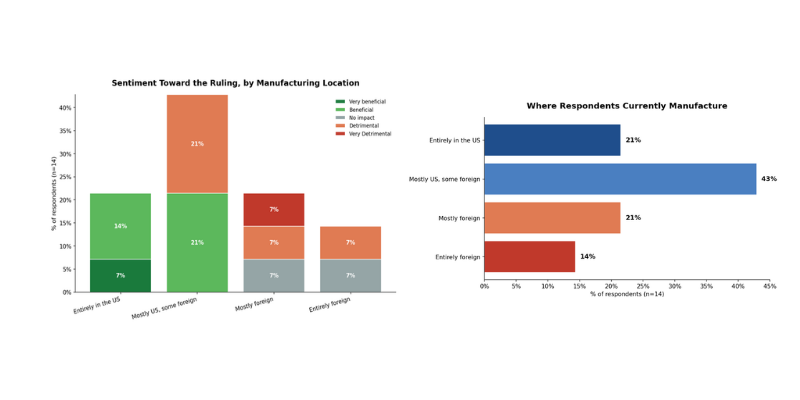
The results show a genuine split rather than a consensus: sentiment tracks closely with a company’s manufacturing footprint. Companies already producing domestically tend to view the ruling as a competitive advantage; companies with foreign-dependent supply chains, even partially, tend to view it as a costly disruption.

2. Sentiment Tracks Manufacturing Footprint
This is the clearest pattern in the data. Every company manufacturing entirely or mostly in the US reported the ruling as beneficial or better. Every company manufacturing mostly or entirely overseas reported it as detrimental, no-impact, or worse — with the two “very detrimental / very beneficial” outliers sitting at opposite ends of the manufacturing spectrum.
3. Business Impact: Roadmap vs. Fundraising
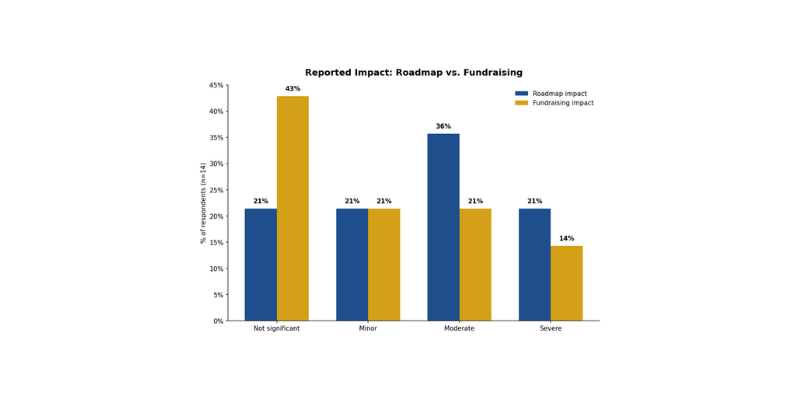
Companies were asked to rate the ruling’s impact on both their product roadmap and their fundraising separately. Roadmap impact was reported as somewhat more disruptive on average than fundraising impact, though fundraising produced the two most extreme responses in the entire survey — one company expecting a severe positive boost (already compliant) and one expecting a severe negative hit (needing to relocate its HQ to the US).
4. Onshoring Readiness
Among companies that rely on foreign manufacturing or components, readiness to onshore varies widely. Several have a plan but haven’t started; at least one reports onshoring is simply not feasible for their business given cost-effective robot-arm and power-supply sourcing being concentrated overseas.

5. Who Responded
Respondent companies ranged from very early-stage (1-5 employees) to large, established firms (200+ employees), giving a reasonably broad cross-section of the robotics ecosystem.

6. Recurring Themes in Open-Ended Responses
Sourcing gaps for specific components
Motors, sensors, power supplies / DC-DC converters, and robot arms were repeatedly named as parts that are difficult or costly to source domestically. One respondent noted that virtually every affordable power supply or DC/DC converter is made in East Asia; another flagged robot arms, especially cost-effective ones, as a major exposure if the Covered List definition expands.
Regulatory ambiguity
Multiple companies want clearer, faster guidance on what “Conditional Approval” actually requires, and a number specifically asked for a distinction between allied-country sourcing (e.g., Europe) and non-allied sourcing (e.g., China) – the current rule appears to treat all foreign origin the same.
Policy volatility
Two respondents raised concern less about the substance of the rule and more about how frequently policy changes under the current administration, making multi-year supply chain planning difficult.
Competitive dynamics
One respondent suggested the timing benefits a specific competitor that had already achieved full US sourcing, raising fairness concerns about the rule’s design.
Geopolitical and existential risk
One large company flagged possible Chinese retaliation as a downstream risk. One small company dependent on foreign manufacturing is now considering relocating its headquarters to the US entirely.
7. Support Requested
Ranked roughly by how often each was mentioned:
- Vetted onshoring supplier network — the single most requested form of support
- Legal / regulatory guidance, including help petitioning regulators for clearer rules
- A longer implementation timeline (one company specifically requested ~18 months to migrate supply chains)
- Outright rescission of the rule, from companies that view it as protectionist
- No support needed — several already-compliant companies said the ruling is a net benefit as written
Takeaways for MassRobotics
- There is clear member demand for a vetted onshoring supplier network — this is the most actionable, concrete ask across responses and a candidate for a MassRobotics-convened resource.
- Regulatory clarity (especially on “Conditional Approval” and allied vs. non-allied sourcing) is a recurring pain point that could be addressed through a member advisory or a joint comment letter.
- Impact is uneven, not uniform — messaging and support should be tailored by manufacturing footprint rather than treated as a single industry position.
- Component-level sourcing (power supplies, motors, sensors, robot arms) is the practical chokepoint; any onshoring initiative should prioritize these categories first.
Source: MassRobotics member/sponsor pulse survey, August 17–23, 2026 (n=14 responses) and one-on-one conversations.