Pushing the frontier of generality, intelligence, and capabilities for real operations in the supply chain and beyond.
In 1961, the United States deployed the world’s first industrial robot, a stationary arm working on a General Motors assembly line in New Jersey. 65 years later, too little has changed: only 12% of US factories and 10% of US warehouses have robots, while there are nearly a million unfilled jobs across the supply chain.
At Tutor, we believe the answer is simple: generally capable robots powered by frontier artificial intelligence take automation from an industrial engineering project to a product that any operator can buy. As a vertically integrated robotics platform across research and deployment, Tutor builds general purpose robot hardware and foundation models, enabling our deployment team to implement high value workflows directly into the physical economy.
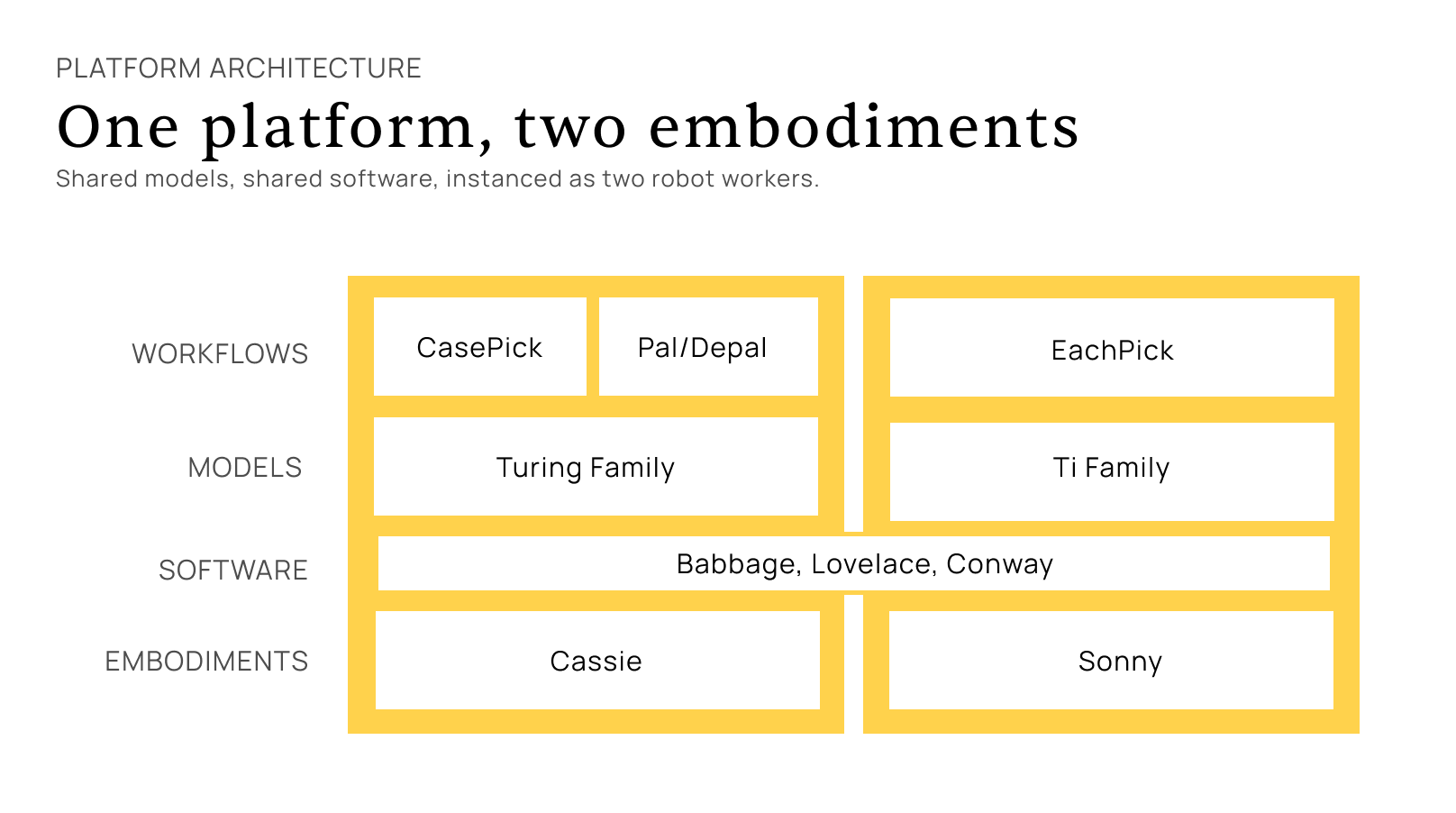
We are excited to share the next generation of Tutor’s robot embodiments Cassie and Sonny, pushing the frontier of generality, intelligence, and capabilities for real operations in the supply chain and beyond. With our next generation Cassie and Sonny robots, Tutor customers are moving beyond narrow automation solutions and towards a new vision of robot labor: generally capable robot worker fleets, flexible to any physical work, delivered in days not years, with immediate ROI. This next generation of Tutor robots is already hard at work in production facilities across the United States, helping to build a more affordable and abundant future in the physical world.
Meet the next-generation Cassie
One intelligent mobile robot for all material handling work in the factory, warehouse and beyond.
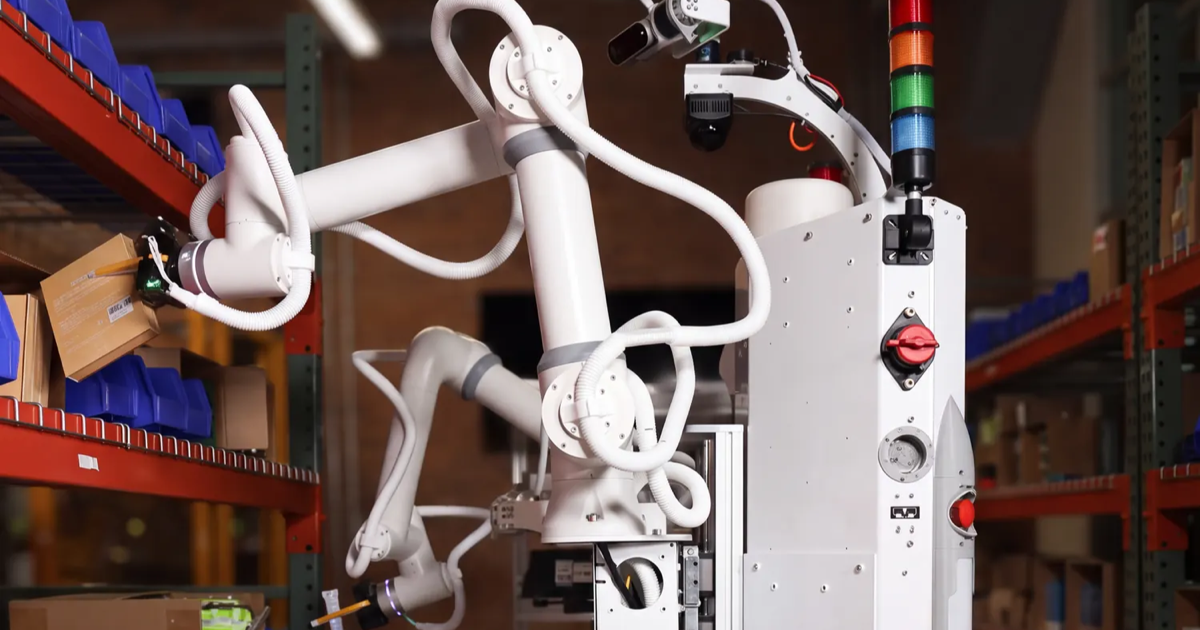
Cassie is Tutor’s workhorse single-armed robot embodiment, proven in production with millions of bulk picks in factories and warehouses across the United States. Powered by Tutor’s Turing 200M parameter foundation model series, Cassie uses her cameras to perceive her environment and perform novel tasks without any programming, operator configuration, or vendor customization. Businesses from family-owned manufacturers all the way to Fortune 50 3PLs use Cassie in critical operations such as de-palletization, induction, end of line palletization, and repackaging. Cassie makes all of these tasks accessible with affordable, no-commitment usage-based pricing, providing instant ROI.
Cassie is picking the first day of most deployments, with ~40 day median timing from signed paperwork to robots in production. With the next generation Cassie, the same Turing AI models get a massive hardware upgrade, built to unlock new bulk handling applications for Tutor customers and make Cassie even faster to implement.
Cassie is now fully autonomously mobile through a facility, with four wheels and enough battery life to make it through more than a shift without needing a charge. For mostly stationary applications like induction and palletizing, Cassie is now even faster to implement, with onboard vacuum generation and no physical install, and mobility means Cassie can now drive between workstations, letting factory operators get the most out of their robot by switching between different tasks and work areas.
With mobility comes a whole new set of workflows for Tutor customers with their Cassie robots. This fall, Cassie is deploying for the first time into full end-to-end case picking operations, providing complete B2B fulfillment automation for $0 CapEx and no major facility retrofits. B2B fulfillment is a $100B+ problem for Tutor customers across 3PL, distribution, manufacturing, retail and grocery, and Cassie offers the first drop-in solution that pencils out for brownfield facilities.
Tutor is also doubling down on operator safety with next-generation Cassie. In addition to ISO-certified collaborative hardware and intelligent 2D LiDAR, Cassie now has two 3D LiDAR sensing units for even more advanced human detection and collision-free autonomous navigation. These new LiDAR units (combined with a myriad of other major upgrades across sensing, actuation, and compute) provide an even more robust and general harness for Tutor’s foundation models, advancing the frontier of what jobs robots can do in the physical world.
Meet the next-generation Sonny
General dexterity ready for industry, as a workforce for warehouse fulfilmment, kitting, and more.
Tutor’s goal is to build generally capable robot workers, and few form factors are as general as the human body. Humans have remarkable perception, dexterity, and the ability to tackle an enormous diversity of tasks in the physical world. How do we build an embodiment with those capabilities but optimized for the warehouse, that is sufficiently robust, safe, and cost-effective to deploy at scale across the physical economy?
Meet Tutor’s next-generation Sonny embodiment, with dexterity and task generality approaching the human form. Building on our prototype Sonny robot used in our groundbreaking research building the largest robot data collection factory in the Western hemisphere with Data Factory 1, our next-generation Sonny embodiment is built for the rigors and realities of industrial work.
The term “humanoid” is often used to describe human-like robot embodiments. As different US and international players work to design and manufacture this new class of embodiments, there is an increasing gap between the general promise of a robot and what that hardware can actually deliver. Human-like robots need to be cost effective, manufacturable at scale, safe around people, and reliable enough to operate for long periods of time without maintenance.
The next-generation Sonny was designed at the intersection between Tutor’s cutting edge foundation model research and our frontier deployment work. Our goal was to build a robot that’s sufficiently generally capable to perform trillions of dollars of economic labor (unlocked only by greater model capabilities), while being practical to deploy and deliver large-scale customer value today. Sonny will be our first deployed robot running our newest Ti0 4.5B parameter Vision-Language-Action robot foundation model (VLA), providing a research and deployment path to unlimited task generality and dexterity.
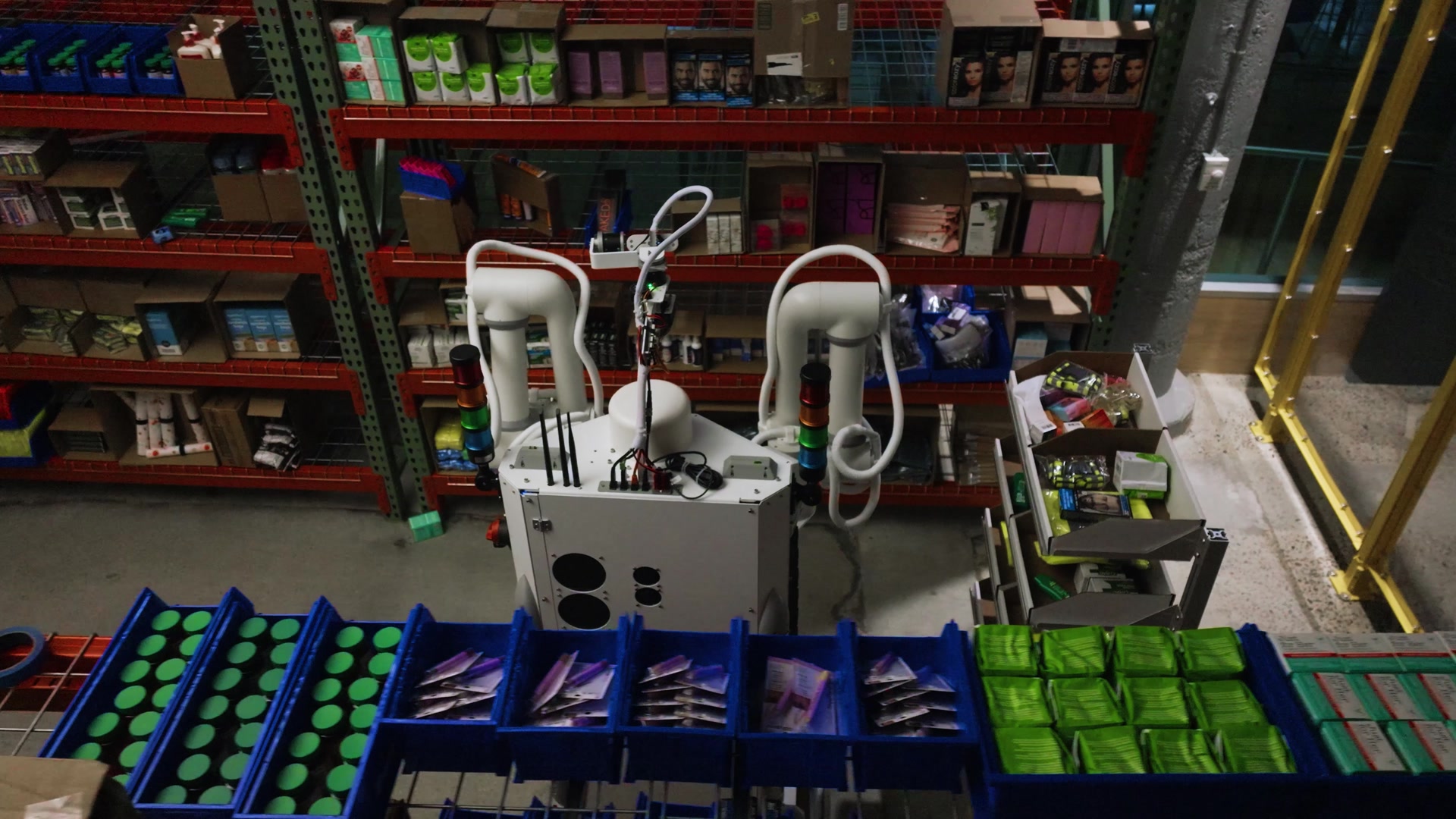
Sonny’s first job is e-commerce fulfillment, with the capability to autonomously navigate brownfield warehouses, pick arbitrary items out of racking, and deliver completed orders to packout. E-commerce picking is one of the hardest, most menial jobs in the warehouse, with high turnover and hundreds of thousands of unfilled positions.
As Tutor scales Sonny deployments in e-commerce, we’re working closely with our partners to expand the scope of tasks and environments on the platform, including assembly-line packaging and assembly tasks in manufacturing and maintenance tasks across the industrial supply chain.
Towards robots everywhere
At Tutor, we believe robotics will only be solved through the unification of research and deployment. Science done purely in the lab or custom-built industrial automation can only advance the frontier so far. There is no internet of training data for the physical world, and the greatest capabilities in modern language models have come from doing real work, not reading about it. The only place a robot can learn what the physical world truly demands is in a real production deployment.
Tutor’s next generation of robots are built for that real work. The foundation models that run on Cassie and Sonny (Turing and Ti0) are trained on millions of real-world robot interactions, unlocking 1-day implementations and a fleet that is more productive every day. Turning models into a complete labor solution is only possible by building our own hardware: our customers don’t want a quarter-inch drill, they want the quarter-inch hole. Owning the embodiment means full control of the harness for our models and experience for our customers.
Tutor’s fleet is growing 20% month over month and we are rapidly scaling robot manufacturing in the United States to meet demand. If you are an owner or operator of a business in need of robot labor, please contact our team to learn how Cassie and Sonny can support your real-world operations.